

On Average, What Percent Of Registered Voters Vote?
The historical trends in voter turnout in the The states presidential elections accept been determined by the gradual expansion of voting rights from the initial restriction to white male person property owners aged 21 or older in the early years of the land's independence to all citizens anile 18 or older in the mid-20th century. Voter turnout in United States presidential elections has historically been higher than the turnout for midterm elections.[one]

Approximately 240 one thousand thousand people were eligible to vote in the 2020 presidential ballot and roughly 66.1% of them submitted ballots, totaling about 158 million. Biden received about 81 million votes, Trump most 74 meg votes, and other candidates (including Jo Jorgensen and Howie Hawkins) a combined approximately 3 million votes.
History of voter turnout [edit]

U.Southward. presidential election popular vote totals every bit a per centum of the full U.Due south. population. The black line is the total turnout, while colored lines reflect votes for major parties. This chart represents the number of votes cast every bit a pct of the total population, and does not compare either of those quantities with the per centum of the population that was eligible to vote.[3]
Early 19th century: Universal white male suffrage [edit]
The gradual expansion of the right to vote from only property-owning men to include all white men over 21 was an important movement in the menses from 1800 to 1830.[4] Older states with property restrictions dropped them, namely all but Rhode Island, Virginia and Northward Carolina by the mid-1820s. No new states had property qualifications, although three had adopted taxation-paying qualifications – Ohio, Louisiana and Mississippi, of which only in Louisiana were these significant and long-lasting.[5] The process was peaceful and widely supported, except in Rhode Island. In Rhode Island, the Dorr Rebellion of the 1840s demonstrated that the demand for equal suffrage was broad and stiff, although the subsequent reform included a significant property requirement for any resident built-in outside of the Usa. Even so, costless blackness men lost voting rights in several states during this period.[half-dozen]
The fact that a human being was now legally allowed to vote did non necessarily mean he routinely voted. He had to exist pulled to the polls, which became the most important part of the local parties. These parties systematically sought out potential voters and brought them to the polls. Voter turnout soared during the 1830s, reaching about lxxx% of the adult male population in the 1840 presidential election.[vii] Taxation-paying qualifications remained in simply five states past 1860 – Massachusetts, Rhode Island, Pennsylvania, Delaware and North Carolina.[8]
Some other innovative strategy for increasing voter participation and input followed. Prior to the presidential election of 1832, the Anti-Masonic Party conducted the nation's kickoff presidential nominating convention. Held in Baltimore, Maryland, September 26–28, 1831, it transformed the process by which political parties select their presidential and vice-presidential candidates.[9]
1870s: African American male suffrage [edit]
The passage of the Fifteenth Amendment to the United States Constitution in 1870 gave African American men the right to vote. While this historic expansion of rights resulted in significant increases in the eligible voting population and may take contributed to the increases in the proportion of votes cast for president equally a percentage of the total population during the 1870s, there does not seem to have been a pregnant long-term increment in the percent of eligible voters who plow out for the poll. The disenfranchisement of about African Americans and many poor whites in the South during the years 1890–1910 likely contributed to the decline in overall voter turnout percentages during those years visible in the chart beneath.
Early 1920s: Women'south suffrage [edit]
There was no systematic collection of voter turnout data by gender at a national level earlier 1964, but smaller local studies betoken a low turnout among female person voters in the years following Women's suffrage in the United states. For instance, a 1924 study of voter turnout in Chicago plant that "female person Chicagoans were far less probable to have visited the polls on Election Day than were men in both the 1920 presidential election (46% vs. 75%) and the 1923 mayoral contest (35% vs. 63%)."[10] The study compared reasons given by male and female non-voters and constitute that female non-voters were more probable to cite full general indifference to politics and ignorance or timidity regarding elections than male not-voters, and that female voter were less likely to cite fear of loss of business or wages. Most significantly, notwithstanding, 11% of female non-voters in the survey cited a "Atheism in woman's voting" as the reason they did non vote.
The graph of voter turnout percentages shows a dramatic decline in turnout over the first ii decades of the twentieth century, ending in 1920 when the Nineteenth Subpoena to the Usa Constitution granted women the correct to vote across the United States. Only in the preceding decades, several states had passed laws supporting women'due south suffrage. Women were granted the right to vote in Wyoming in 1869, before the territory had get a full state in the spousal relationship. In 1889, when the Wyoming constitution was drafted in preparation for statehood, it included women's suffrage. Thus Wyoming was also the first full state to grant women the right to vote. In 1893, Colorado was the first state to amend an existing constitution in lodge to grant women the right to vote, and several other states followed, including Utah and Idaho in 1896, Washington State in 1910, California in 1911, Oregon, Kansas, and Arizona in 1912, Alaska and Illinois in 1913, Montana and Nevada in 1914, New York in 1917; Michigan, Due south Dakota, and Oklahoma in 1918. Each of these suffrage laws expanded the body of eligible voters, and because women were less likely to vote than men, each of these expansions created a decline in voter turnout rates, culminating with the extremely low turnouts in the 1920 and 1924 elections after the passage of the Nineteenth Amendment.
This voting gender gap waned throughout the heart decades of the twentieth century.
Age, teaching, and income [edit]
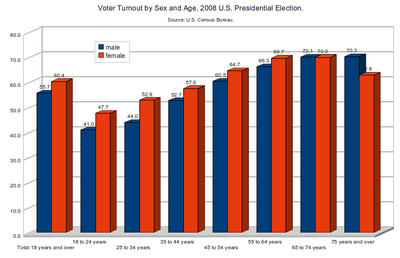
Voter turnout by sex and age for the 2008 U.Southward. Presidential Election.
Historic period, income, and educational attainment are pregnant factors affecting voter turnout. Educational attainment is perchance the best predictor of voter turnout, and in the 2008 election, those holding avant-garde degrees were three times more likely to vote than those with less than high school teaching. Income correlated well with the likelihood of voting as well. The income correlation may be because of a correlation betwixt income and educational attainment, rather than a directly issue of income.[ citation needed ]
Age [edit]
The age difference is associated with youth voter turnout. Some debate that "age is an important factor in agreement voting blocs and differences" on various issues.[11] Others argue that young people are typically "plagued" by political apathy and thus do not accept strong political opinions.[12] Every bit strong political opinions may be considered ane of the reasons backside voting,[13] political apathy among young people is arguably a predictor for low voter turnout. One study found that potential young voters are more willing to commit to voting when they see pictures of younger candidates running for elections/office or voting for other candidates, surmising that young Americans are "voting at college and similar rates to other Americans when there is a candidate under the age of 35 years running".[14] As such, since most candidates running for office are pervasively over the age of 35 years,[15] youth may not be actively voting in these elections considering of a lack of representation or visibility in the political process.
Recent decades have seen increasing concern over the fact that youth voter turnout is consistently lower than turnout among older generations. Several programs to increase the rates of voting among young people – such as MTV's "Rock the Vote" (founded in 1990) and the "Vote or Die" initiative (starting in 2004) – may have marginally increased turnouts of those between the ages of xviii and 25 to vote. However, the Stanford Social Innovation Review found no evidence of a decline in youth voter turnout. In fact, they argue that "Millennials are turning out at like rates to the previous 2 generations when they confront their first elections."[xvi]
Education [edit]

Rates in voting in the 2008 U.S. Presidential Election by educational attainment
Pedagogy is some other factor considered to take a major impact on voter turnout rates. A study by Burman investigated the relationship betwixt formal education levels and voter turnout.[17] This report demonstrated the effect of rising enrollment in college education circa 1980s, which resulted in an increase in voter turnout. Nonetheless, "this was not truthful for political knowledge";[17] a rise in educational activity levels did not have any bear on in identifying those with political knowledge (a signifier of civic engagement) until the 1980s election, when higher instruction became a distinguishing factor in identifying civic participation. This article poses a multifaceted perspective on the effect of educational activity levels on voter turnout. Based on this commodity, one may surmise that education has become a more than powerful predictor of civic participation, discriminating more than betwixt voters and non-voters. Notwithstanding, this was not true for political knowledge; educational activity levels were not a signifier of political cognition. Gallego (2010) also contends that voter turnout tends to exist higher in localities where voting mechanisms take been established and are easy to operate – i.e. voter turnout and participation tends to be high in instances where registration has been initiated by the state and the number of balloter parties is small-scale. One may debate that ease of access – and not education level – may be an indicator of voting beliefs. Presumably larger, more urban cities will have greater budgets/resources/infrastructure dedicated to elections, which is why youth may accept college turnout rates in those cities versus more rural areas. Though youth in larger (read: urban) cities tend to exist more than educated than those in rural areas (Marcus & Krupnick, 2017), perhaps in that location is an external variable (i.east. election infrastructure) at play. Smith and Tolbert's (2005) research reiterates that the presence of ballot initiatives and portals within a state have a positive effect on voter turnout. Another correlated finding in his report (Snyder, 2011) was that education is less important as a predictor of voter turnout in states than tend to spend more than on education. Moreover, Snyder's (2011) enquiry suggests that students are more likely to vote than non-students. It may be surmised that an increase of state investment in balloter infrastructure facilitates and education policy and programs results in increase voter turnout among youth.
Income [edit]
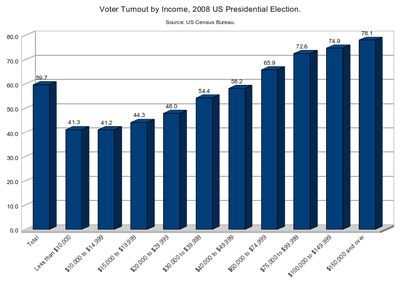
Rates of voting in the 2008 U.S. Presidential Election by income
Wealthier people tend to vote at higher rates. Harder and Krosnick (2008) contend that some of the reasons for this may exist due to "differences in motivation or ability (sometimes both)" (Harder and Krosnick, 2008), or that less wealthy people have less energy, time, or resources to allot towards voting. Another potential reason may exist that wealthier people believe that they have more at stake if they don't vote than those with less resources or income. Maslow's hierarchy of needs might besides help explain this hypothesis from a psychological perspective. If those with low income are struggling to see the basic survival needs of food, water, prophylactic, etc., they will not be motivated enough to reach the final stages of "Esteem" or "Self-actualization" needs (Maslow, 1943) – which consist of the desire for dignity, respect, prestige and realizing personal potential, respectively.
Gender gap [edit]
Since 1980, the voting gender gap has completely reversed, with a college proportion of women voting than men in each of the last nine presidential elections. The Eye for American Women and Politics summarizes how this trend can be measured differently both in terms of proportion of voters to non-voters, and in terms of the bulk number of votes cast. "In every presidential election since 1980, the proportion of eligible female adults who voted has exceeded the proportion of eligible male adults who voted [...]. In all presidential elections prior to 1980, the voter turnout charge per unit for women was lower than the charge per unit for men. The number of female voters has exceeded the number of male voters in every presidential election since 1964..."[18] This gender gap has been a determining gene in several contempo presidential elections, equally women accept been consistently about 15% more likely to support the candidate of the Democratic Party than the Republican candidate in each election since 1996.[19]
Race and ethnicity [edit]

Voter turnout in the 2008 U.S. Presidential Election by race/ethnicity.
Race and ethnicity has had an effect on voter turnout in recent years, with information from recent elections such equally 2008 showing much lower turnout among people identifying as Hispanic or Asian ethnicity than other voters (see chart to the right). One gene impacting voter turnout of African Americans is that, equally of the 2000 election, 13% of African American males are reportedly ineligible to vote nationwide because of a prior felony conviction; in certain states – Florida, Alabama, and Mississippi – disenfranchisement rates for African American males in the 2000 election were around 30%.[xx]
Other eligibility factors [edit]
Another factor influencing statistics on voter turnout is the percentage of the land's voting-age population[ clarification needed ] who are ineligible to vote due to not-citizen status or prior felony convictions. In a 2001 article in the American Political Science Review, Michael P. McDonald and Samuel Popkin argued, that at least in the United states, voter turnout since 1972 has non really declined when calculated for those eligible to vote, what they term the voting-eligible population.[21] [ description needed ] In 1972, noncitizens and ineligible felons (depending on land law) constituted most 2% of the voting-age population. By 2004, ineligible voters constituted nearly ten%.[22] Ineligible voters are not evenly distributed across the country, roughly 15% of California's voting-age population is ineligible to vote – which confounds comparisons of states.[23]
Turnout statistics [edit]
The following table shows the available data on turnout for the voting-historic period population (VAP) and voting-eligible population (VEP) since 1936.[24]
| Election | Voting-historic period Population (VAP)[25] | Voting-eligible Population (VEP)[25] | Turnout[25] | % Turnout of VAP[25] [ clarification needed ] | % Turnout of VEP[25] |
|---|---|---|---|---|---|
| 1932 | 75,768,000 | 39,817,000 | 52.half-dozen% | ||
| 1936 | 80,174,000 | 45,647,000 | 56.9% | ||
| 1940 | 84,728,000 | 49,815,000 | 58.8% | ||
| 1944 | 85,654,000 | 48,026,000 | 56.1% | ||
| 1948 | 95,573,000 | 48,834,000 | 51.1% | ||
| 1952 | 99,929,000 | 61,552,000 | 61.6% | ||
| 1956 | 104,515,000 | 62,027,000 | 59.3% | ||
| 1960 | 109,672,000 | 68,836,000 | 62.eight% | ||
| 1964 | 114,090,000 | 70,098,000 | 61.4% | ||
| 1968 | 120,285,000 | 73,027,000 | 60.7% | ||
| 1972 | 140,777,000 | 77,625,000 | 55.one% | ||
| 1976 | 152,308,000 | 81,603,000 | 53.6% | ||
| 1980 | 163,945,000 | 159,635,102 | 86,497,000 | 52.8% | 54.2% |
| 1984 | 173,995,000 | 167,701,904 | 92,655,000 | 53.three% | 55.2% |
| 1988 | 181,956,000 | 173,579,281 | 91,587,000 | 50.iii% | 52.8% |
| 1992 | 189,493,000 | 179,655,523 | 104,600,000 | 55.ii% | 58.ii% |
| 1996 | 196,789,000 | 186,347,044 | 96,390,000 | 49.0% | 51.seven% |
| 2000 | 209,787,000 | 194,331,436 | 105,594,000 | fifty.3% | 54.three% |
| 2004 | 219,553,000 | 203,483,455 | 122,349,000 | 55.vii% | threescore.i% |
| 2008 | 229,945,000 | 213,313,508 | 131,407,000 | 57.1% | 62.5% |
| 2012 | 235,248,000 | 222,474,111 | 129,235,000 | 53.8% | 58.0% |
| 2016 | 249,422,000 | 230,931,921 | 136,669,276 | 54.eight% | 59.2% |
| 2020[23] | 257,605,088 | 239,247,182 | 159,690,457 | 62.0% | 66.ix% |
Notation: The Bipartisan Policy Center has stated that turnout for 2012 was 57.5 percent of the voting-age population (VAP),[ clarification needed ] which they claim was a pass up from 2008. They estimate that as a pct of eligible voters, turnout was: 2000, 54.2%; in 2004 60.4%; 2008 62.3%; and 2012 57.v%.[26]
The BPC 2012 vote count is low because their certificate was written just after the 2012 election, before final counts were in. Their voting-eligible population (VEP)[ clarification needed ] does not include adjustments for felons (see p.13). The U.s. Elections Projection, by Michael McDonald calculates VEP including citizenship and adjustments for felons. The site'due south data on turnout equally percentage of eligible voters (VEP), is slightly higher and like to BPC: 2000 55.iii%, 2004 threescore.7%, 2008 62.ii%, 2012 58.6%. McDonald'due south voter turnout information for 2016 is 60.1% and 50% for 2018.[27]
Later analysis by the Academy of California, Santa Barbara's American Presidency Projection plant that there were 235,248,000 people of voting age in the The states in the 2012 election, resulting in 2012 voting historic period population (VAP) turnout of 54.nine%.[28] The total increment in VAP between 2008 and 2012 (5,300,000) was the smallest increase since 1964, bucking the modern average of 8,000,000–13,000,000 per wheel.
Run across as well [edit]
- Voter turnout
- Voter registration in the Us
References [edit]
- ^ New York Times Editorial Board (Nov 11, 2014). "Opinion | The Worst Voter Turnout in 72 Years". The New York Times. ISSN 0362-4331. Retrieved January 29, 2018.
- ^ "Voter Turnout By State 2021". worldpopulationreview.com . Retrieved July 27, 2021.
- ^ Encounter "National Turnout Rates, 1787-2018" (United States Election Project)
- ^ Keyssar, The Right to Vote: The Contested History of Democracy in the United States (2009) ch ii
- ^ Engerman, pp. 8–9
- ^ Murrin, John Chiliad.; Johnson, Paul E.; McPherson, James G.; Fahs, Alice; Gerstle, Gary (2012). Freedom, Equality, Power: A History of the American People (6th ed.). Wadsworth, Cengage Learning. p. 296. ISBN978-0-495-90499-1.
- ^ William G. Shade, "The 2nd Party System". in Paul Kleppner, et al. Development of American Electoral Systems (1983) pp. 77–111
- ^ Engerman, p. 35. Tabular array ane
- ^ William Preston Vaughn, The Anti-Masonic Party in the United States: 1826–1843 (2009)
- ^ Allen, Jodie T. (March 18, 2009). "Reluctant Suffragettes: When Women Questioned Their Correct to Vote". Pew Research Center . Retrieved Jan 29, 2018.
- ^ Berman; Johnson (2000). "Historic period, ambition, and the local charter: a written report in voting behavior".
- ^ Catapano, Tyler (2014). "?".
- ^ Munsey (2008). "Why We Wrote: Why do we vote?". APA Monitor. 39 (half dozen): 60.
- ^ Pomante; Schraufnagel (2014). "Candidate Historic period and Youth Voter Turnout". American Politics Enquiry. 43 (3): 479–503. doi:10.1177/1532673x14554829. S2CID 156019567.
- ^ Struyk (2017). "The Democratic Party has an historic period problem". CNN.
- ^ Kiesa, Abby; Levine, Peter (March 21, 2016). "Exercise We Really Want Higher Youth Voter Turnout?". Stanford Social Innovation Review . Retrieved January 29, 2018.
- ^ a b Burden, B. (2009). "The dynamic furnishings of education on voter turnout". Electoral Studies. 28 (four): 540–549. doi:10.1016/j.electstud.2009.05.027.
- ^ "Gender Differences in Voter Turnout" (PDF). Rutgers University Middle for American Women and Politics. July 20, 2017. Retrieved January 29, 2018.
- ^ Waldman, Paul (March 17, 2016). "Opinion | Why the 2016 ballot may produce the largest gender gap in history". Washington Post . Retrieved Jan 29, 2018.
- ^ Written report: Non-Voting Felons Increasing, ABC News, January six, 2006.
- ^ McDonald, Michael P.; Popkin, Samuel Fifty. (December 2001). "The Myth of the Vanishing Voter". The American Political Scientific discipline Review. 95 (4): 963–974. doi:x.1017/S0003055400400134. JSTOR 3117725. S2CID 141727274.
- ^ "2004G - Usa Elections Projection". www.electproject.org . Retrieved Oct 31, 2020.
- ^ a b "2020g - United States Elections Project". www.electproject.org . Retrieved October 31, 2020.
- ^ "Denominator - Usa Elections Projection".
- ^ a b c d due east "Voter Turnout in Presidential Elections | The American PresidencyProject". www.presidency.ucsb.edu . Retrieved January 8, 2021.
- ^ "2012 Election Turnout Dips Beneath 2008 and 2004 Levels: Number Of Eligible Voters Increases By Viii 1000000, Five Million Fewer Votes Cast" (PDF). Bipartisan Policy Middle. November viii, 2012. Retrieved January 29, 2018.
- ^ "Voter Turnout Data - United States Elections Projection". www.electproject.org . Retrieved October 31, 2020.
- ^ "Voter Turnout in Presidential Elections". UC Santa Barbara American Presidency Project . Retrieved January 29, 2018.
Farther reading [edit]
- Berman, D. and Johnson, R. (2000). Age, ambition, and the local charter: a study in voting behavior. The Social Scientific discipline Journal, 37(1), pp. nineteen–26.
- Burden, Barry C. (2009). "The dynamic effects of education on voter turnout". Electoral Studies. 28 (4): 540–549. doi:10.1016/j.electstud.2009.05.027.
- Gallego, A. (2010). Agreement unequal turnout: Education and voting in comparative perspective. Electoral Studies, 29(2), pp. 239–248.
- Gershman, C. (2018). Democracy and Democracies in Crisis. Retrieved from [1][usurped!]; also at https://isnblog.ethz.ch/politics/democracy-and-democracies-in-crunch
- Harder, J. and Krosnick, J. (2008). Why Do People Vote? A Psychological Assay of the Causes of Voter Turnout. Journal of Social Issues, 64(3), pp. 525–549.
- Marcus, J., & Krupnick, M. (2017). The Rural Higher-Didactics Crisis. The Atlantic. Retrieved from https://world wide web.theatlantic.com/education/archive/2017/09/the-rural-higher-pedagogy-crunch/541188/
- Maslow, A. (1943). A theory of human motivation. Psychological Review, fifty(4), pp. 370–396.
- McDonald, Michael, United States Elections Project, http://world wide web.electproject.org/dwelling house
- Munsey, C. (2008). Why exercise we vote ?. American Psychological Association.
- Pomante, Michael J.; Schraufnagel, Scot (2015). "Candidate Age and Youth Voter Turnout". American Politics Enquiry. 43 (3): 479–503. doi:10.1177/1532673x14554829. S2CID 156019567.
- Snyder, R. (2011). The impact of age, education, political noesis and political context on voter turnout. UNLV Theses, Dissertations, Professional person Papers, And Capstones.
- Struyk, R. (2017). The Autonomous Political party has an age problem. CNN. [online] Available at: https://www.cnn.com/2017/10/x/politics/democrats-age-trouble/index.html [Accessed June 9, 2018].
- The Economist (2014). Why immature people don't vote. [online] Available at: https://www.economist.com/the-economist-explains/2014/ten/29/why-young-people-dont-vote [Accessed June 9, 2018].
- Tolbert, Caroline J.; Smith, Daniel A. (2005). "The Educative Effects of Election Initiatives on Voter Turnout". American Politics Enquiry. 33 (ii): 283–309. doi:x.1177/1532673x04271904. S2CID 154470262.
External links [edit]
- "National Turnout Rates, 1787-2018" (United states of america Ballot Project)

Source: https://en.wikipedia.org/wiki/Voter_turnout_in_United_States_presidential_elections
Posted by: kuntzhowestrin.blogspot.com
0 Response to "On Average, What Percent Of Registered Voters Vote?"
Post a Comment